Special Offer: Free Initial Consultation for New ClientsFree Initial Consultation for New Clients
Book Now
NeuroperformaNeuroperforma450-445-1010
450-445-1010
Why consult?
For Who?
Our Solutions
Free Resources
Our Clinics
FREN
Why consult?
For Who?
Our Solutions
Free Resources
Our Clinics
Free Phone Consultation

No diagnosis • No commitment • 30 minutes

Medias

rTMS in Quebec: options for quick access to treatment

The repetitive transcranial magnetic stimulation (rTMS) exists: it is scientifically validated and it is available in Quebec, but accessing it is not as simple as booking an appointment with a family doctor. The first decision to make is which route to take: the public system or a private clinic. These two options are not at […]

Neuroperforma
Neuroperforma
September 9, 20266 minutes read
Supervision by a CMQ psychiatrist

    The repetitive transcranial magnetic stimulation (rTMS) exists: it is scientifically validated and it is available in Quebec, but accessing it is not as simple as booking an appointment with a family doctor. The first decision to make is which route to take: the public system or a private clinic. These two options are not at odds: they respond to different needs and situations and many people who could benefit from this protocol simply do not know where to begin.
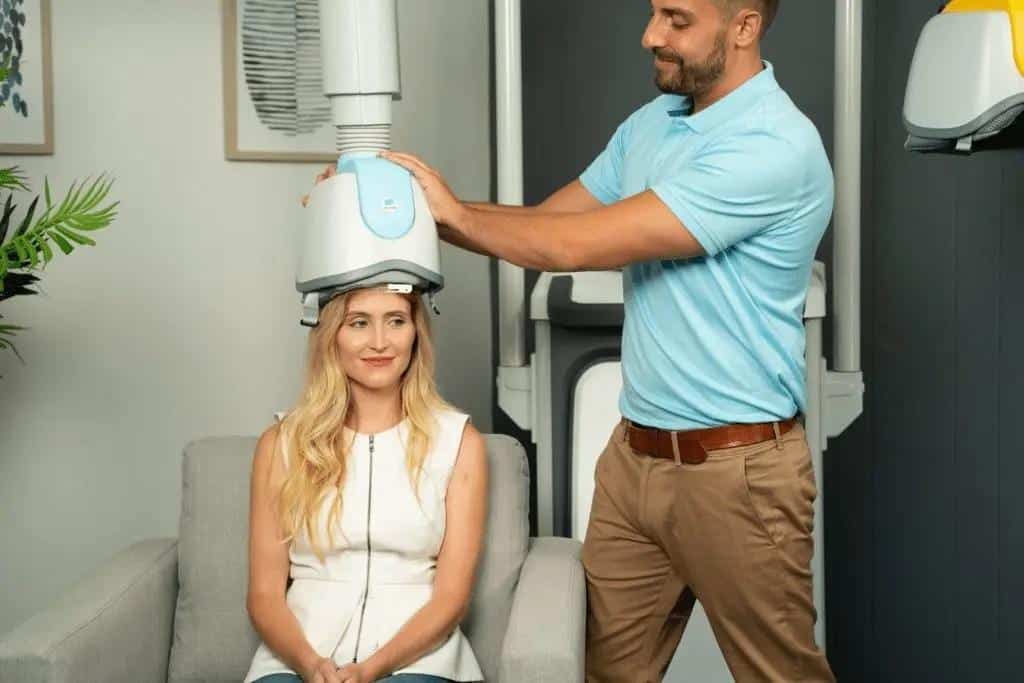
    Coil placement during rTMS

    One figure is enough to illustrate the scale of the challenge: in 2025, only 536 patients had access to rTMS in Quebec’s public system, while the number of Quebecers living with treatment-resistant depression is estimated at 65,000. The gap speaks for itself, and it explains in large part why so many people are now turning to other options to gain faster access to this treatment. To understand what rTMS is and who it is for before addressing the question of access, our article Everything You Need to Know About rTMS is a good starting point.

    The public system: covered by RAMQ, but under strain

    rTMS is reimbursed by RAMQ since 2013, as part of a psychiatric prescription for refractory depression. Quebec is also among the few Canadian provinces, along with Alberta and Saskatchewan, to offer public coverage for this protocol. In these regions, rTMS can be prescribed and administered in certain hospitals or public clinics, generally for patients suffering from depression resistant to conventional treatments.

    The limits, however, are very real:

    • there are currently 17 rTMS devices in Quebec, concentrated in only seven health regions. The INESSS recommends adding 27 more devices, which would make it possible to treat 7,504 more people over five years.
    • In the meantime, wait times vary from one week to six months depending on the region, and even in provinces where rTMS is covered, waiting lists can stretch over several months.

    This situation reflects both the limited number of centers offering this solution and a growing demand for this non-invasive alternative. The Ministry of Health and Social Services has taken note of the INESSS report, but has not yet taken an official position on access to and development of rTMS in health care institutions; further analytical work will need to be done.

    Supervision by a CMQ psychiatrist

    The public route is particularly suited to people whose treating psychiatrist practices in a region with a device, to those who can wait several weeks to a few months without immediate clinical risk, and to those who do not have private insurance. For these people, the free protocol more than makes up for the wait, especially when psychiatric follow-up continues actively during this period.

    The private sector: faster, more flexible, with varying costs

    The Quebec health system faces significant structural pressures, which result in delays and gaps in access to care. In this context, turning to a private clinic becomes a practical decision that many Quebecers face, not only for rTMS.

    In a private clinic, access is generally without a waiting period or with a very short waiting period. Newer protocols are also available there, including Deep TMS with the H-Coil, which makes it possible to target deeper and broader brain areas than standard rTMS. At Neuroperforma, the intensive SWIFT protocol offers a condensed pace of 10 visits over 5 weeks, rather than the 36 sessions spread over 9 weeks of the standard protocol. According to data published by Hanlon and colleagues in the journal Brain Stimulation (2026), this protocol shows a response rate of 87.8% and a remission rate of 78% in the studied population, though individual results may vary and a psychiatric evaluation remains necessary to determine whether this protocol is suitable for each situation.

    In terms of costs, Deep TMS with the SWIFT protocol at Neuroperforma is offered at a price of $7,960, including the psychiatric evaluation, 38 sessions, support from the clinical team and post-treatment follow-up. This protocol is not covered by RAMQ in a private clinic. Some private insurance plans, as well as certain programs for veterans or members of the Canadian Armed Forces, may cover it, in part or in full.

    The private route is particularly suitable for people:

    • whose treatment-resistant depression is active and for whom waiting several months would pose a clinical risk or a significant decline in quality of life,
    • who live in a region not served by the public system,
    • who want access to newer protocols not offered in the public system, as well as those partially covered by group or supplementary insurance.

    Comparison table

    Public system

    Private clinic (e.g., Neuroperforma)

    Coverage

    RAMQ (under conditions)

    Not covered by RAMQ; private insurance possible

    Access delay

    1 week to 6 months depending on the region

    Fast (often a few days to weeks)

    Available technology

    Standard rTMS

    Deep TMS, SWIFT protocol

    Duration

    ~9 weeks (36 sessions)

    ~5 weeks (10 visits, 38 sessions)

    Supervision

    Psychiatrist in the public system

    Psychiatric evaluation included + dedicated team

    Regional availability

    7 regions out of 17 in Quebec

    Clinic in Saint-Hubert (Greater Montreal)

    Patient cost

    $0 (RAMQ)

    $7,960 (full SWIFT protocol)

    What do the data say about public-private complementarity for rTMS?

    The Quebec government recognizes that the public and private systems can be complementary in improving access to care, reducing waiting times and better organizing available services. In the case of rTMS, this complementarity is particularly relevant:

    • the public system offers free access,
    • the private sector offers speed and newer protocols.

    The right choice depends on each patient’s clinical, geographic and financial situation and should always be made in consultation with a psychiatrist, as part of a shared decision-making process. The Neuroperforma article on misconceptions about rTMS can also help sort fact from fiction before making a decision.

    How do you get started in practice? The two routes, step by step

    Public route:

    1. Consult your family doctor or treating psychiatrist.
    2. Ask for an evaluation for refractory depression (criterion: failure of at least two different antidepressants).
    3. Obtain a referral to a hospital center offering rTMS in your region.
    4. Sign up for the waiting list and maintain psychiatric follow-up while waiting.

    Private route (Neuroperforma):

    1. Contact us for a free 15-minute initial assessment, with no prior diagnosis or commitment.
    2. Complete the evaluation with the psychiatrist, included in the program.
    3. Begin the protocol according to availability, usually quickly.
    4. Benefit from integrated post-protocol follow-up.

    Conclusion

    Neither option is inherently better than the other: the right path is the one that matches the patient’s reality today, their region, their level of clinical risk and their financial situation. Some people even start by joining the public system’s waiting list while simultaneously exploring available private options, so as not to let time slip away needlessly. What matters is not being left without a solution for lack of information. If you are wondering which of these two routes is right for your situation, speaking with the Neuroperforma team is a good starting point.

    Book your free initial assessment (15 min) →

    [DISCLAIMER_TMS_QC_FR]
    [
    CANMAT_REF_TMS]

    Our latest blog articles

    Prefrontal Cortex: the brain’s decision-making center

    Prefrontal Cortex: the brain’s decision-making center

    The prefrontal cortex plays a central role in decision-making, attention management, and behavioral control. It is involved whenever a situation needs to be analyzed, a choice made, or an impulse resisted. However, its capabilities are not unlimited. They strongly depend on: So what are the levers that can improve the daily functioning of the prefrontal […]

    Neuroperforma
    Neuroperforma
    June 8, 20263 min read
    How to hack the flow state to boost mental performance?

    How to hack the flow state to boost mental performance?

    There are moments when work becomes effortless. Attention locks in, distractions fade away, and everything flows without conscious effort. This is what is known as the flow state. Hacking the flow state means organizing the cognitive conditions that allow the brain to enter a stable state of concentration. From a mental performance perspective, it is […]

    Neuroperforma
    Neuroperforma
    June 2, 20264 min read
    Supervision by a CMQ psychiatrist
    Medias

    rTMS in Quebec: options for quick access to treatment

    The repetitive transcranial magnetic stimulation (rTMS) exists: it is scientifically validated and it is available in Quebec, but accessing it is not as simple as booking an appointment with a family doctor. The first decision to make is which route to take: the public system or a private clinic. These two options are not at […]

    Neuroperforma
    Neuroperforma
    September 9, 20266 min read
    “Illustration of how transcranial magnetic stimulation works”ⓒ Eric Wassermann, M.D., Public domain, via Wikimedia Commonshttps://upload.wikimedia.org/wikipedia/commons/6/67/Transcranial_magnetic_stimulation.jpg?utm_source=commons.wikimedia.org&utm_campaign=index&utm_content=original
    Medias

    5 misconceptions about transcranial magnetic stimulation (rTMS)

    Transcranial magnetic stimulation (rTMS) has existed in Quebec for more than twenty years. It has been covered by the RAMQ since 2013 in the public network and was just officially validated by the Institut national d'excellence en santé et en services sociaux (INESSS) in January 2026. And yet, many people who could benefit from it […]

    Neuroperforma
    Neuroperforma
    September 4, 20266 min read
    A woman wearing an SMTr coil
    Medias

    Is SMTr cost-effective for our health care system? What the INESSS says

    Depression is a condition that affects the family, loved ones, and society as a whole. It has a massive collective cost, often invisible to those who do not live with it up close. Before asking whether SMTr costs too much, perhaps we should ask the question differently: how much does inaction cost? According to the […]

    Neuroperforma
    Neuroperforma
    September 1, 20266 min read
    Magnetic stimulation coil positioned on a patient

    rTMS: an option against medication-resistant depression

    Living with depression that resists treatment is a profoundly exhausting experience, both for the person affected and for those around them. Thousands of Quebecers consult, try one antidepressant, then another, without ever regaining lasting well-being. Between 2018 and 2022, the use of antidepressants continued to increase in Quebec, a sign that the demand for relief […]

    Neuroperforma
    Neuroperforma
    August 27, 20266 min read
    Theta Waves: When the Brain Daydreams at School

    Theta Waves: When the Brain “Daydreams” at School

    You may know a student who always seems elsewhere, whose eyes are on the board while their mind appears to be somewhere else. This behaviour is not necessarily due to a lack of interest or effort. For some people living with ADHD, it may reflect differences in how the brain regulates its level of activation […]

    Neuroperforma
    Neuroperforma
    August 14, 20266 min read
    Delta Waves: The Physical Key to Recovery

    Delta Waves: The Physical Key to Recovery

    When ADHD is discussed, attention, impulsivity, and hyperactivity are often the main focus. Yet one dimension is rarely addressed: sleep, and more specifically, the quality of deep sleep governed by Delta waves. Without proper overnight recovery, even a brain that is well supported during the day cannot function at full capacity. The brain needs periods […]

    Neuroperforma
    Neuroperforma
    August 11, 20265 min read
    Alpha Waves and ADHD: Calming the Emotional Storm

    Alpha Waves and ADHD: Calming the Emotional Storm

    Have you ever noticed that some people with ADHD seem constantly on edge, as though their brain does not know how to press “pause”? This is not a lack of willpower. It is often linked to dysregulation of Alpha waves, the electrical signals naturally produced by the brain to help it calm down and manage […]

    Neuroperforma
    Neuroperforma
    August 6, 20266 min read
    Neuroleadership: Optimizing Decision-Making as a Manager

    Neuroleadership: Optimizing Decision-Making as a Manager

    Decision-making is at the core of every manager’s role. It relies on precise brain mechanisms, particularly involving the prefrontal cortex, attentional capacities, and cognitive load management. Neuroleadership focuses precisely on this reality: How can you improve your neuroleadership? These levers are directly aligned with improving mental and cognitive performance, particularly in attention management and decision-making. […]

    Neuroperforma
    Neuroperforma
    June 15, 20262 min read
    Prefrontal Cortex: the brain’s decision-making center

    Prefrontal Cortex: the brain’s decision-making center

    The prefrontal cortex plays a central role in decision-making, attention management, and behavioral control. It is involved whenever a situation needs to be analyzed, a choice made, or an impulse resisted. However, its capabilities are not unlimited. They strongly depend on: So what are the levers that can improve the daily functioning of the prefrontal […]

    Neuroperforma
    Neuroperforma
    June 8, 20263 min read
    How to hack the flow state to boost mental performance?

    How to hack the flow state to boost mental performance?

    There are moments when work becomes effortless. Attention locks in, distractions fade away, and everything flows without conscious effort. This is what is known as the flow state. Hacking the flow state means organizing the cognitive conditions that allow the brain to enter a stable state of concentration. From a mental performance perspective, it is […]

    Neuroperforma
    Neuroperforma
    June 2, 20264 min read
    Supervision by a CMQ psychiatrist
    Medias

    rTMS in Quebec: options for quick access to treatment

    The repetitive transcranial magnetic stimulation (rTMS) exists: it is scientifically validated and it is available in Quebec, but accessing it is not as simple as booking an appointment with a family doctor. The first decision to make is which route to take: the public system or a private clinic. These two options are not at […]

    Neuroperforma
    Neuroperforma
    September 9, 20266 min read
    “Illustration of how transcranial magnetic stimulation works”ⓒ Eric Wassermann, M.D., Public domain, via Wikimedia Commonshttps://upload.wikimedia.org/wikipedia/commons/6/67/Transcranial_magnetic_stimulation.jpg?utm_source=commons.wikimedia.org&utm_campaign=index&utm_content=original
    Medias

    5 misconceptions about transcranial magnetic stimulation (rTMS)

    Transcranial magnetic stimulation (rTMS) has existed in Quebec for more than twenty years. It has been covered by the RAMQ since 2013 in the public network and was just officially validated by the Institut national d'excellence en santé et en services sociaux (INESSS) in January 2026. And yet, many people who could benefit from it […]

    Neuroperforma
    Neuroperforma
    September 4, 20266 min read
    Neuroperforma

    Need clarity?

    Speak with an advisor to understand your options, with no diagnosis or commitment required.

    Free phone consultation

    30 minutes • No diagnosis • No commitment • 14+ years of expertise • 10,000+ patients supported

    About Us

    • Our team
    • Why Choose Us

    Clinics

    • Laval
    • Sherbrooke
    • Gatineau
    • Québec
    • Lévis
    • Montréal Centre-Ville
    • Montréal Ouest
    • Terrebonne
    • Trois-Rivières
    • Saint-Hubert (Clinique SMT)

    Client Space

    Please note that online appointment booking for neurofeedback sessions is only available for clients who have already completed their evaluation with the psychologist.

    Book Online Appointment

    Head Office

    7750 Boul. Cousineau, suite 301
    Saint-Hubert
    Québec, J3Z 0C8
    450-445-1010[email protected]

    Join our team!

    Join a dynamic and motivated team!

    Discover our available positions

    © 2026 Neuroperforma. All rights reserved.